Drive along the 101 through Camarillo and you'll notice something unusual.
An airport.
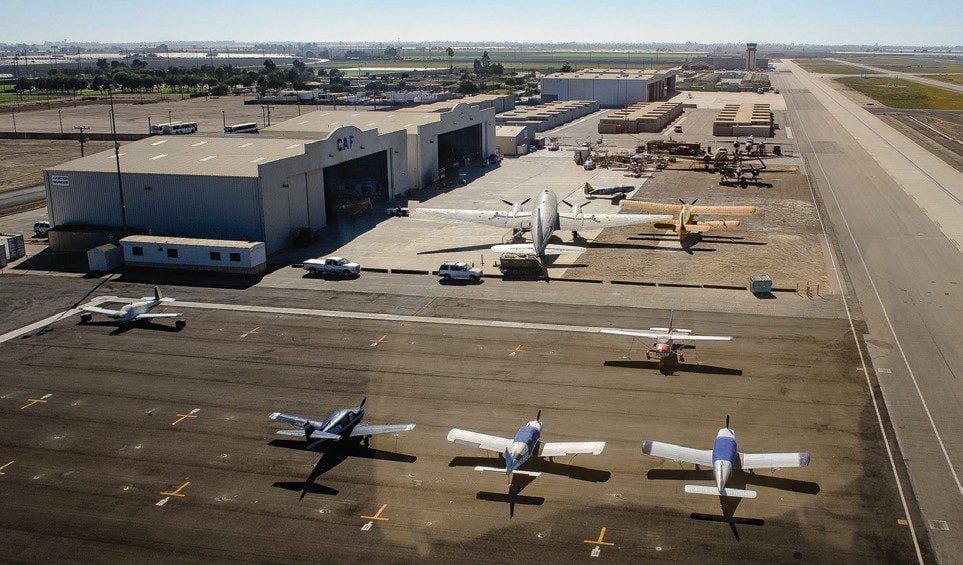
Not a tiny landing strip tucked away in the countryside. A substantial aviation facility with hangars, a control tower, corporate jets, and a runway stretching across hundreds of acres.
It looks like the kind of airport where you might catch a flight to San Francisco or Las Vegas.
Except you can't.
Camarillo Airport doesn't offer scheduled commercial airline service.
And here's the fascinating part.
That's not an accident. It's the result of a decision made nearly 50 years ago.
Before Camarillo Airport, There Was a Military Base
The story begins in 1942, when a landing strip was established on farmland near the eastern edge of the Oxnard Plain.
During World War II, the military used the site for flight training and aircraft maintenance.
Then came the Cold War.
The installation became Oxnard Air Force Base, part of the nation's air defense network.
By the late 1950s, the base had a runway approximately 9,000 feet long, military hangars, housing, recreational facilities, and fighter aircraft assigned to protect Southern California's airspace.
According to the Ventura County Department of Airports' historical account, the base even operated supersonic F-101B Voodoo interceptors during the 1960s.
Think about that the next time you're driving past Camarillo.
The airport beside the freeway was once part of America's Cold War defense system.
The Airport That Almost Became Something Else
When the military deactivated Oxnard Air Force Base in 1969, an important question emerged.
What should happen to the property?
Ventura County saw an opportunity to develop an airport capable of serving commercial aviation alongside private and business aircraft.
But Camarillo had a different vision.
Residents and city leaders were concerned about the consequences of a major commercial airport, including aircraft noise, traffic, and the surrounding community's future development.
The disagreement continued for years.
Eventually, the county and city reached an agreement in 1976.
The former military runway would be shortened to approximately 6,000 feet, and the airport would operate as a general aviation facility rather than a scheduled airline airport.
The agreement established limits that continue to shape airport operations today.
In fact, the Ventura County Airports noise FAQ specifically addresses whether Camarillo will add scheduled airlines, large cargo operations, or a longer runway.
The answer remains no.
One local land-use decision helped determine what kind of airport Camarillo would become for generations.
So What Actually Happens at Camarillo Airport?
Quite a lot.
According to Ventura County's Department of Airports, Camarillo is home to more than 500 general aviation aircraft and typically records between 150,000 and 200,000 takeoffs and landings annually.
That's substantial aviation activity for an airport without scheduled passenger service.
But general aviation is a much broader category than most people realize.
The airport supports private flying, business aviation, flight training, aircraft maintenance, charter operations, and specialized aviation services.
Businesses such as Channel Islands Aviation and Sun Air Jets are part of that ecosystem.
And unlike a commercial airline terminal, where most travelers interact with only a small portion of the operation, Camarillo's aviation activity involves a network of pilots, mechanics, instructors, technicians, and businesses.
It's an airport built around the aviation industry itself, not simply moving passengers through security checkpoints.
There's Even a Flying Museum
One of Camarillo Airport's most interesting attractions is something many Ventura County residents have never visited.
The Commemorative Air Force Southern California Wing operates an aviation museum at the airport dedicated to preserving historic military aircraft.
This isn't simply a collection of photographs and artifacts.
The organization maintains and restores vintage aircraft, including historic warbirds, with some preserved in flying condition.
Visitors can explore aircraft exhibits and observe restoration work from designated viewing areas.
There's something remarkable about standing inside a hangar surrounded by aircraft from another era, knowing that some of these machines are still capable of taking to the sky.
It's a living connection to the history of aviation.
And it's right here in Camarillo.
Why an Airport Matters Even Without Airlines
Most people judge airports by the destinations they can fly to.
But that's only one way to measure their value.
Camarillo Airport supports businesses that require specialized facilities, skilled employees, aircraft storage, maintenance services, and access to regional airspace.
Those activities contribute to the local economy without depending on scheduled commercial passenger flights.
There's also a real estate dimension.
Airports influence surrounding land use, commercial development, transportation planning, and neighborhood considerations.
For nearby property owners, aviation activity can mean both economic benefits and concerns about aircraft noise.
That balance was central to the debate surrounding the airport in the 1970s.
And it remains relevant today.
The airport's history illustrates something important about community planning.
The question isn't always whether development creates economic value. Sometimes it's what kind of development a community is willing to accommodate.
The ROGS Perspective
Camarillo Airport is easy to overlook.
Most residents know it's there. Many have driven past it hundreds of times.
But few realize that the airport began as a military installation, once operated Cold War fighter aircraft, and became the subject of a consequential debate about Ventura County's future.
Nearly half a century later, that debate still influences what happens on the property.
Today, the airport serves pilots, aviation businesses, aircraft owners, and visitors interested in aviation history.
It doesn't have a departure board filled with commercial destinations.
It doesn't need one to matter.
And perhaps that's what makes its story so interesting.
We tend to think of progress as making something bigger.
More flights. More terminals. More passengers. More development.
But Camarillo Airport followed a different path.
It became an important aviation facility without becoming a major airline airport.
The next time you drive past those hangars along the 101, remember: you're not looking at an airport that failed to become something bigger.
You're looking at an airport whose future was deliberately decided by the community around it.