At 4:31 on the morning of January 17, 1994, Southern California was asleep.
Then the ground moved.
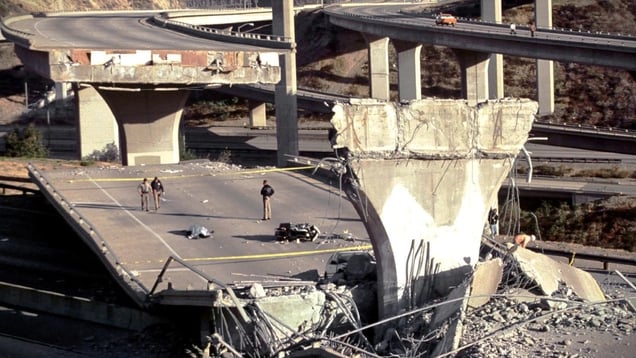
Furniture toppled. Windows shattered. Freeways collapsed. Entire apartment buildings suffered catastrophic damage.
The magnitude 6.7 Northridge earthquake became one of the most destructive earthquakes in modern California history.
Its epicenter was in the San Fernando Valley, but the shaking and damage extended into Ventura County, particularly the eastern communities closest to Los Angeles.
For residents of Simi Valley and the Conejo Valley, it wasn't simply a disaster happening somewhere else.
It was happening at home.
And what followed changed much more than building codes.
It changed what engineers, homeowners, and communities thought they knew about earthquake safety.
The Fault Nobody Could See
Here's one of the most surprising details about the Northridge earthquake.
The fault responsible wasn't an obvious crack running across the landscape.
It was a blind thrust fault, buried beneath the surface.
Unlike faults that leave visible traces, blind thrust faults can produce powerful earthquakes without breaking through the ground above them.
The Southern California Earthquake Data Center explains that the earthquake originated on the Northridge Thrust, deep beneath the San Fernando Valley.
The movement was powerful enough to permanently raise portions of the Santa Susana Mountains.
Think about that.
Mountains familiar to anyone who has driven through eastern Ventura County were physically altered by an event lasting only seconds.
Simi Valley Wasn't Just Watching From Next Door
When people hear "Northridge earthquake," they naturally think of Los Angeles.
But the damage wasn't confined to the San Fernando Valley.
The U.S. Geological Survey documented significant damage extending into Simi Valley and the surrounding mountains.
For Ventura County residents, the earthquake demonstrated that seismic risk doesn't respect city or county boundaries.
The shaking damaged homes and infrastructure, interrupted daily life, and revealed vulnerabilities that weren't always apparent before the earthquake.
Across the wider region, thousands of buildings were damaged, and freeway failures disrupted transportation.
And the earthquake exposed something even more troubling.
Some structures engineers had expected to perform well didn't behave as anticipated.
The Buildings That Surprised the Engineers
Before Northridge, certain steel-frame buildings were considered particularly capable of withstanding earthquake forces.
But investigators discovered unexpected fractures in welded connections between steel beams and columns.
The buildings didn't necessarily collapse.
Instead, critical structural connections cracked under extreme movement.
It was an unsettling discovery because these were engineered buildings, not simply aging structures that had been neglected.
Research by the National Institute of Standards and Technology helped document and investigate these vulnerabilities.
The lessons influenced seismic engineering, construction standards, and the way professionals evaluate existing buildings.
The earthquake also contributed to improvements in bridge design and retrofitting programs.
Sometimes the most important advances in construction happen when a building doesn't perform the way everyone expected.
What This Means for Ventura County Homeowners
Here's where the story becomes relevant to real estate.
Two houses can look nearly identical from the street while having very different earthquake vulnerabilities.
Construction year matters.
So do foundation design, structural connections, building materials, soil conditions, and whether improvements have been made over time.
For certain older wood-frame homes, seismic retrofitting may involve securing the house to its foundation and reinforcing short walls beneath the first floor.
California's Earthquake Brace + Bolt program provides information about these improvements and financial assistance for qualifying homeowners when funding and registration are available.
But no retrofit makes a home earthquake-proof.
And a newer construction date doesn't automatically eliminate every risk.
The important lesson is that earthquake safety deserves more attention than a casual glance at a property's age.
For buyers, it can mean asking questions about structural improvements, permits, foundation conditions, and available geological hazard information.
For homeowners, it can mean understanding the particular vulnerabilities of their property rather than assuming every California house is equally prepared.
The Real Estate Detail You Can't See in a Photograph
Real estate marketing naturally emphasizes the visible.
Kitchens.
Floor plans.
Views.
Outdoor living spaces.
But some of the most consequential characteristics of a property are almost invisible during a showing.
How is the house connected to its foundation?
What type of soil sits beneath it?
Has the structure been modified?
Were previous improvements properly permitted?
These questions aren't as exciting as a remodeled kitchen.
But they're part of understanding what you're purchasing.
The Northridge earthquake demonstrated that a building's performance depends on details most people never see.
And those details can matter enormously when the ground begins moving.
The ROGS Perspective
More than three decades have passed since the Northridge earthquake.
An entire generation of Ventura County homeowners has grown up without experiencing an earthquake of comparable regional impact.
But the lessons remain.
They influence building standards, engineering practices, retrofit programs, and the questions responsible property owners should ask.
There's something remarkable about that.
An event lasting only seconds can change how communities build for generations.
We often think of real estate in terms of location, architecture, and value.
But there's another element beneath every property.
The ground itself.
And perhaps the most important lesson from January 17, 1994, is that understanding a home requires looking beyond what we can see.
Because the strongest home isn't necessarily the one that looks the strongest.
It's the one whose structure has been thoughtfully designed, evaluated, and maintained for the forces it may someday face.