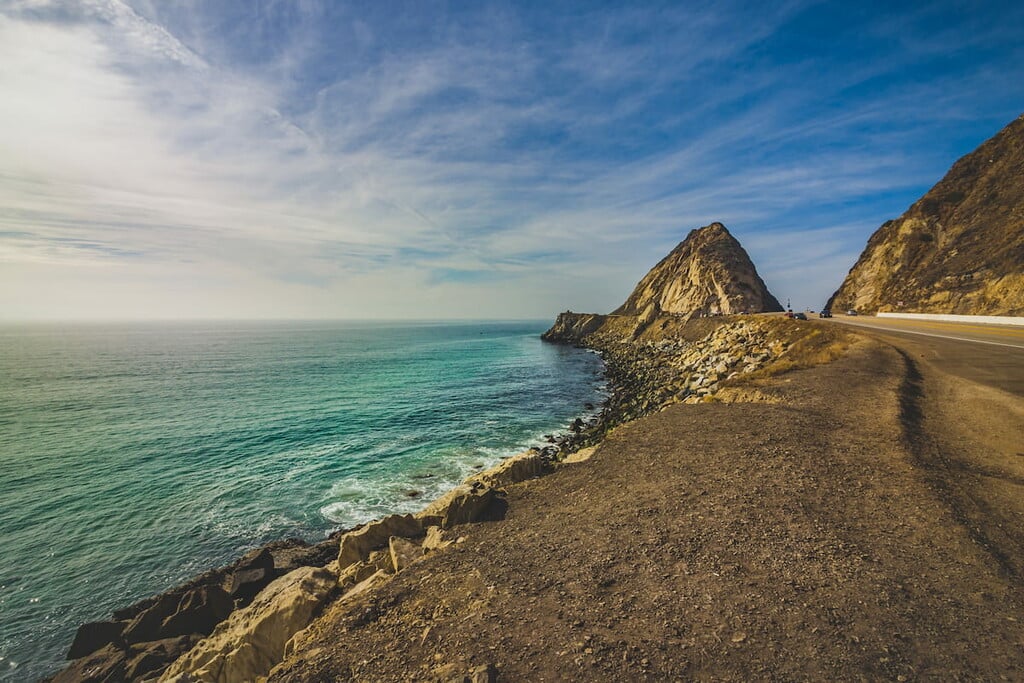
There's a moment when driving south along Pacific Coast Highway when Ventura County seems to become somewhere else.
The agricultural plains disappear. The familiar coastal neighborhoods fall behind you. The mountains suddenly push toward the ocean, and the road begins following a narrow strip of land between towering rock formations and the Pacific.
Then you reach Point Mugu.
If someone showed you a photograph of this coastline without telling you where it was taken, you might guess Big Sur.
Or somewhere along the Mediterranean.
You probably wouldn't guess you're just a short drive from Oxnard.
But that's what makes this stretch of Ventura County so remarkable.
The landscape changes completely, even though you've barely left home.
The Place Where the Mountains Meet the Pacific
Most people think of Southern California's coastline as a long sequence of beaches, neighborhoods, piers and palm trees.
Point Mugu interrupts that picture.
Here, the western end of the Santa Monica Mountains meets the Pacific Ocean, creating steep cliffs, rocky headlands, secluded coves and an unusually dramatic coastal highway.
It's part of what makes Point Mugu State Park so distinctive.
The park encompasses more than 14,000 acres of coastal and mountain terrain, including miles of shoreline and trails winding through canyons and ridgelines.
And unlike many of Southern California's most photographed coastal destinations, this landscape hasn't been completely surrounded by development.
You can still look toward the mountains and see mountains.
Not rows of rooftops.
Not commercial centers.
Not subdivisions climbing every available hillside.
Just the rugged landscape itself.
The Rock That Became a Landmark
One of the most recognizable features of this coastline is Mugu Rock.
It's the enormous rock formation rising beside Pacific Coast Highway, where the road appears to squeeze between the mountains and the ocean.
What makes it fascinating isn't just its appearance.
It's that the road itself helped create the landmark we recognize today.
When engineers carved a passage through the coastal ridge in the 1930s, they transformed the landscape, leaving the dramatic rock face that motorists photograph today.
A formation shaped by millions of years of geology became a modern landmark through a relatively recent engineering project.
And there's another detail many people don't know.
Point Mugu was designated Ventura County Landmark No. 14 in 1971.
The name itself comes from the Chumash word muwu, meaning beach. Long before Pacific Coast Highway existed, this coastline was part of a landscape inhabited and traveled by Chumash communities for thousands of years.
There's an Ancient Geological Story Underneath All of This
Here's where the landscape becomes even more interesting.
The Santa Monica Mountains are part of California's Transverse Ranges, a system of mountains that generally run east to west rather than following the more familiar northwest-to-southeast orientation of many California ranges.
Their complicated history includes tectonic movement, uplift, volcanic activity and ancient marine sediments.
According to the National Park Service's geological history of the Santa Monica Mountains, some rock formations now found high in the mountains originated underwater.
Imagine standing on a ridgeline overlooking the Pacific, knowing that portions of the rock beneath your feet were once part of an ancient seafloor.
That's a different way of thinking about a coastal view.
The mountains aren't simply sitting beside the ocean.
They're part of a geological story that has been unfolding for millions of years.
The Best View Might Be Above the Highway
Most people experience Point Mugu through their windshield.
But the landscape becomes even more impressive when you leave the road.
The Mugu Peak Trail climbs into the coastal mountains, offering expansive views of the Pacific, surrounding ridgelines and, on clear days, the Channel Islands.
Nearby, the trails around La Jolla Valley and Sycamore Canyon reveal another side of the park: grasslands, oak and sycamore habitats, and deep inland canyons that feel remarkably removed from the coastline.
Point Mugu State Park has more than 70 miles of hiking trails, yet plenty of Ventura County residents know it primarily as the beautiful stretch of highway they pass on the way to Malibu.
That's part of the irony.
Some of the county's most extraordinary landscapes are also the easiest to overlook because they're so familiar.
Why This Matters Beyond the Scenery
There's a tendency to think about communities through their neighborhoods, shopping centers, schools and housing markets.
But geography comes first.
The mountains, coastline, canyons and open spaces influence where roads can go, where development happens and how communities connect.
Point Mugu offers a particularly dramatic reminder of that relationship.
Here, the landscape has dictated the shape of the road rather than the other way around.
And the protected parkland preserves an environment that would be difficult, if not impossible, to recreate once lost.
It's one of those places where the value of open space becomes immediately understandable.
Not because of a statistic.
Because you can see it.
The ROGS Perspective
Ventura County has plenty of places worth visiting.
But some of the most interesting are the ones we've stopped noticing.
Point Mugu is easy to treat as a scenic drive, a familiar rock formation or the stretch of highway between Oxnard and Malibu.
Yet behind that familiar view is a remarkable combination of geological history, Indigenous heritage, conservation and natural beauty.
And perhaps that's the most interesting thing about this coastline.
It doesn't look like the Southern California we usually imagine.
It looks older.
Wilder.
Less predictable.
The next time you're driving along Pacific Coast Highway, consider giving yourself a little extra time.
Stop somewhere safe and designated.
Look toward the mountains.
Look toward the ocean.
And remember that just beyond the neighborhoods, freeways and everyday routines of Ventura County, there's an entirely different landscape waiting.
Sometimes the most extraordinary part of where you live is the part you've driven past a hundred times.